Walking, a vector for transformation
We observe that something transforms when a group walks in nature.
Movement initiates a dynamic of change, stepping back allows for a broader perspective, and nature acts as a supportive framework, both a mirror and a source of inspiration.
A form of serenity settles in, allowing us to approach situations with a renewed perspective and access other forms of perception and intelligence.
The effects of walking in nature are today widely documented by scientific research:
- Increased mental clarity: improvement in attention and executive functions after exposure to nature
- Stress reduction: significant decrease in anxiety and rumination
- Stimulated creativity: up to+60% new ideas after a walk (Stanford University study)
- Measurable effects on the brain: reduction of activity in stress-related areas after immersion in nature
Scientific foundations (selection)
- Berman, M. G. et al. (2008), Psychological Science
- Bratman, G. N. et al. (2015), PNAS
- Oppezzo, M. & Schwartz, D. (2014), Stanford University
- Twohig-Bennett, C. & Jones, A. (2018), Environmental Research
- Park, B. J. et al. (2010), Environmental Health and Preventive Medicine
The WalkUP approach is inspired by recognised experts such as Otto Scharmer (MIT), Nick Craig, and Jon Kabat-Zinn.
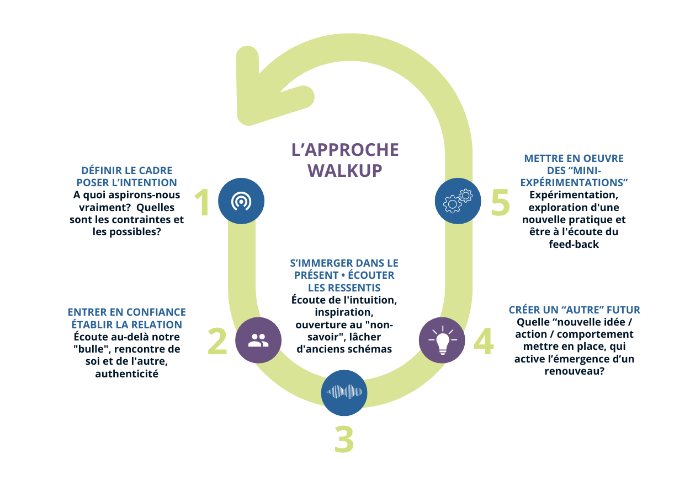
The WalkUP approach is inspired by recognised experts such as Otto Scharmer (MIT), Nick Craig, and Jon Kabat-Zinn.
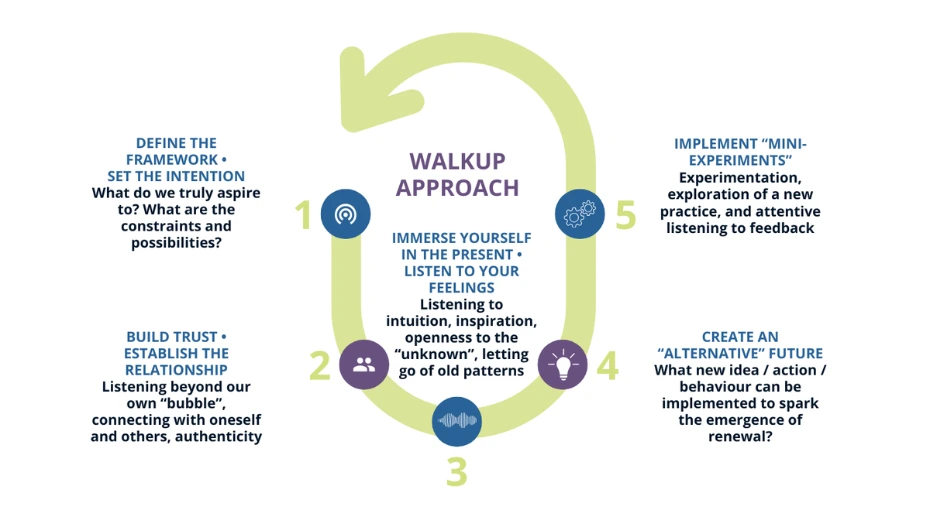
The WalkUP approach is inspired by recognised experts such as Otto Scharmer (MIT), Nick Craig, and Jon Kabat-Zinn.
How does it work?
Whether it is a one-day process or one that spans several months, the programme necessarily includes:
- A time for starting and connecting to prepare for the meeting
- A time for reflective walks accompanied and guided (framework, facilitation, training)
- A time for debriefing among group members
The walks take place in the forest, in Belgium, near your company.
What actually happens?
The meeting alternates between moments of silence, integration, and times for reflection, either alone or in groups, as well as moments for sharing and collective exchanges.
This promotes experiential learning through various exercises or awareness experiences that are lived and felt.
The meetings are framed/structured by two complementary facilitators.
Example of a Walkup support programme
You wish to strengthen team cohesion, support the establishment of a new dynamic, or create a space to bring forth your purpose.
1. Framing
Discussion with several team members and a 1-hour meeting (in-person or remote) to clarify the issues.
2. Getting started
Half-day walk to establish a climate of trust and encourage authentic communication. Individual coaching possible.
3. Deepening
One or more days of walking (or residential format 2–3 days) to explore issues and broaden perspectives.
4. Co-creation
Collaborative workshop to bring forth concrete and shared solutions.
5. Implementation
Definition of an action plan and support for follow-up.
We recommend between 2 and 4 weeks between the different stages. The whole process can take from 3 to 6 months.